This Was Not a Normal CCTV Job
At AMNS, we were not asked to “install cameras.”
The requirement was very specific:
“We need reliable thermal monitoring in a high-heat industrial zone.”
Now that sounds simple on paper.
But anyone who has worked inside a steel plant knows — this is where most systems start
failing.
The Problem Was Not Visibility. It Was Environment
When we visited the site, a few things were immediately clear:
- Heat levels were consistently high
- There was strong infrared radiation from nearby processes
- Dust and vibration were part of daily operation
- And most importantly — the system had to run continuously
This is not a place where you can afford:
- Wrong readings
- Signal disturbance
- Or system downtime
Because here, wrong data is more dangerous than no data.
Where Most Installations Go Wrong
We’ve seen this pattern many times:
- A good thermal camera is selected
- It is installed in a standard housing
- Everything works fine… initially
And then slowly:
- Readings start drifting
- Images lose clarity
- Sensors get stressed
Nobody notices immediately.
Until the system is actually needed.
So We Changed the Approach
Instead of focusing only on the camera,
we focused on what the camera is exposed to.
That changed everything.
The Key Decision: Protect Without Disturbing
Thermal Camera in Industrial Conditions
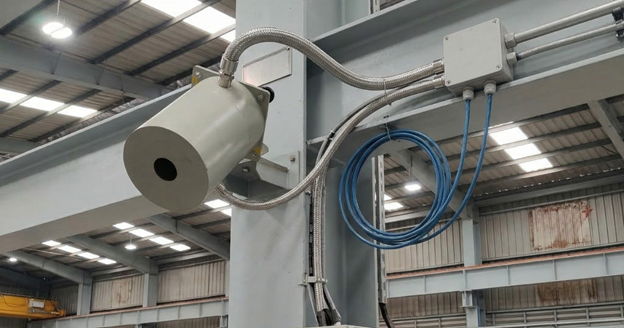
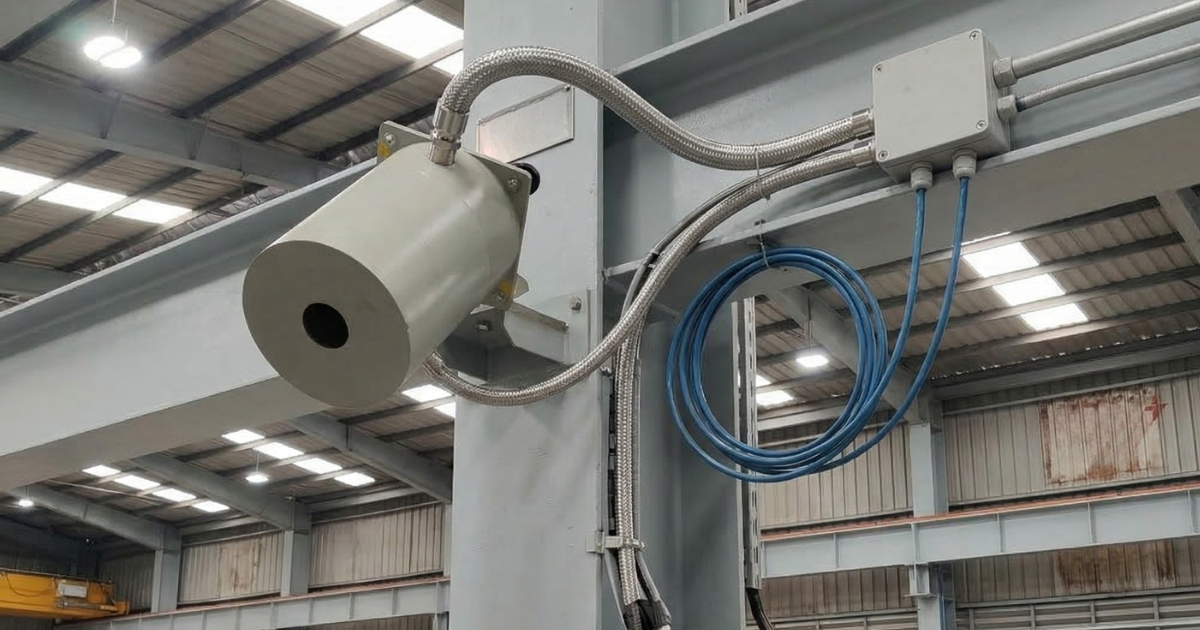
We installed the camera inside an explosion-proof housing.
But the real decision was about the front interface.
We used Germanium glass.
Why This Small Detail Matters
Normal glass does not work well with infrared.
It either blocks or distorts the signal.
Germanium, on the other hand:
- Allows infrared to pass through properly
- Maintains accuracy of temperature readings
- Protects the sensor at the same time
This is one of those things that doesn’t look important —
but it defines whether the system will work after 3 months.
Then Came the System Side
Connecting Field to Control Room
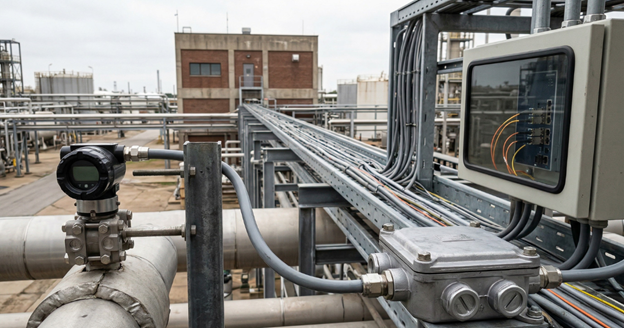
We built the system keeping reliability in mind:
- 4–20 mA output for integration
- Shielded cabling to avoid noise
- Explosion-proof junction box
- Fiber communication using SFP modules
- Integration with the DDC system
Distance was around 400 meters —
so communication stability was equally important.
What Changed After Implementation
Nothing dramatic on the surface.
No “wow” visuals.
No flashy dashboards.
But the important things changed:
- Readings stayed stable
- System kept running without interruption
- Data could be trusted
And in this kind of environment, that’s the real success.
One Thing This Project Reinforced for Us
In industrial systems:
You don’t design for installation day.
You design for day 200.
Because that’s when the real test begins.
Final Thought
People often ask:
“Which camera is best?”
The better question is:
“Will it still work correctly after months in this environment?”
That’s where most decisions go wrong.
About Transit Electronics Ltd.
Transit work on surveillance and monitoring systems where conditions are not ideal —
industrial sites, critical environments, and places where reliability matters more than features.